The Four Movements
One theme, four rooms. A single continuous work, heard start to finish.
The Theme
A rising leap, answered by a stepwise fall — the four-note idea that carries the entire work.
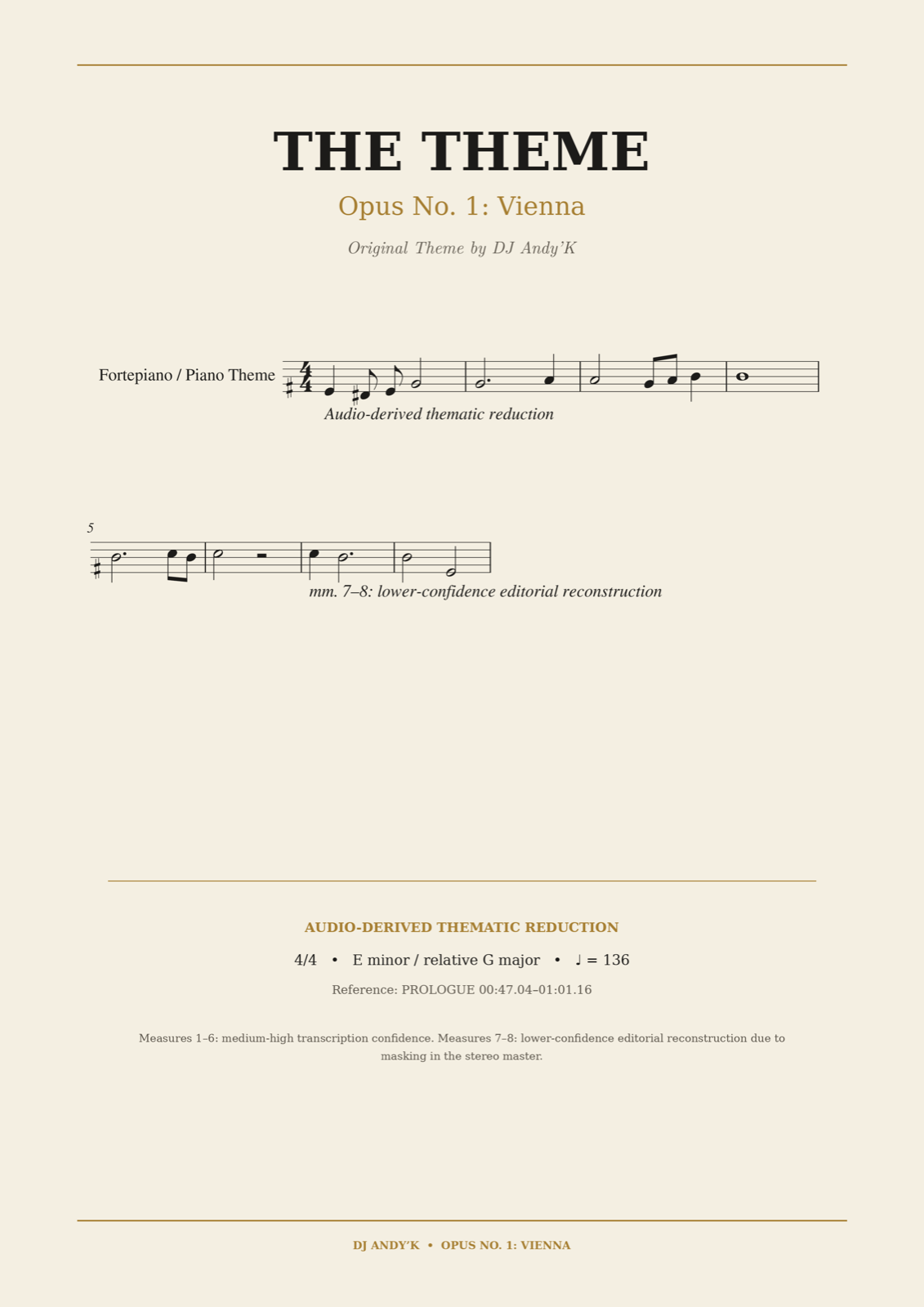
Introduced
Stated alone by the fortepiano in the Prologue — E minor, 136 BPM, fully exposed.
Developed
Harmonised by strings, passed through the orchestra, its rising interval eventually becoming the trance lead.
Returned
Restated exactly as in the Prologue at the close of the Coda — the same four notes, changed by everything in between.
From Orchestra to Trance
Every section has a specific destination in the production — nothing is simply added on top.
Introduces and preserves the central theme.
Carry the main melody, later performing alongside the trance lead.
Move from emotional harmonic support into rhythmic ostinato.
Connect the acoustic low end with the electronic rolling bassline.
Provide scale, warmth and harmonic expansion.
Connect orchestral impact with modern electronic rhythm.
Becomes the new heartbeat, without replacing the orchestra.
Carries the same theme first introduced acoustically.
Virtual Orchestra — Stage Layout
A standard modern seating plan, bird’s-eye view from above the conductor.
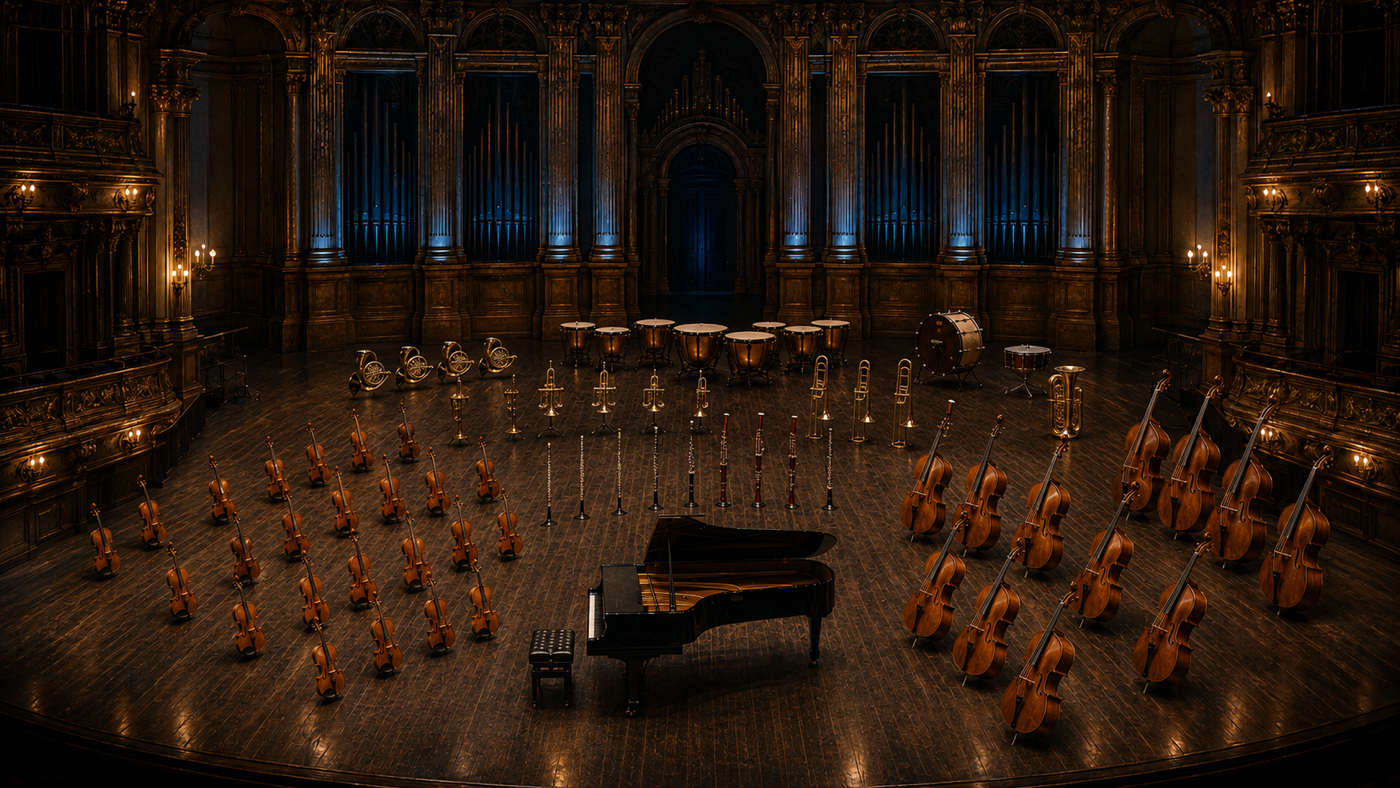
The fortepiano sits in the traditional soloist position — front, closest to the conductor — reflecting its role as the work’s thematic through-line. No harp is used anywhere in this composition.
About the Virtual Orchestra
Opus No. 1: Vienna is composed and orchestrated for a full symphonic ensemble. The orchestral performance is realised through virtual instruments and sampled orchestral libraries, shaped, arranged and integrated into a modern progressive-trance production.
No real musicians or orchestras are claimed — this document credits the composition and its virtual realisation only, unless real performers are confirmed for a future live adaptation.
Credits
- Composed, Arranged, Produced & Mixed by
- DJ Andy’K
- Orchestration & Programming
- DJ Andy’K
- Virtual Orchestra Performance
- Sample-based & synthesised realisation
- Art Direction & Design
- DJ Andy’K
- Origin
- Vienna · 2026
Artistic Note
Opus No. 1 is not intended as a reconstruction of historical music.
It uses the language and atmosphere of Vienna’s classical tradition as the beginning of an original contemporary composition — fortepiano, string writing, thematic development, the discipline of a movement.
The past is not copied. It becomes the foundation for something new: the same theme, carried into progressive trance without losing what it was at the start.
Prologue
The work begins with a single musical idea. An intimate fortepiano introduces the central Vienna theme before the orchestra gradually surrounds it.
This is the musical DNA of the entire work. Everything that follows grows from these first notes.
The Awakening
The theme begins to move. Strings become more rhythmic. A distant electronic heartbeat appears.
Acoustic and electronic worlds begin to recognise each other. The orchestra does not disappear. It awakens.
The Final Movement
The separation disappears. Fortepiano, strings, orchestral percussion, electronic rhythm and progressive trance now exist inside the same musical space.
The original theme reaches its largest form.
Coda
After the climax, the layers begin to disappear. The electronic heartbeat becomes distant. The orchestra withdraws. The original instrument returns.
For the first time, the theme is allowed to finish.
Credits & Tracklist
One continuous work, sequenced and mastered as four movements.
- Composed, Arranged, Produced & Mixed by
- DJ Andy’K
- Orchestration & Programming
- DJ Andy’K
- Virtual Orchestra Performance
- Sample-based & synthesised realisation
- Mastering
- DJ Andy’K
- Art Direction & Design
- DJ Andy’K
- Origin
- Vienna, Austria · 2026
Download the Score
Editorial transcription from the stereo masters — piano/conductor reduction. Inner orchestral voicings are condensed as chord symbols.
℗ & © 2026 DJ Andy’K. All rights reserved. No real orchestra, conductor or studio is credited or implied; instrumentation is a virtual/compositional realisation. No harp is used anywhere in this work.
Hear the Work
Four movements, one continuous listen.
Platform links will go live at release — placeholders shown above.